Unveiling soon.
Advancing women's financial inclusion in Ethiopia.
The second annual scorecard from the National Bank of Ethiopia - benchmarking 32 banks on women's leadership, use of financial products, and financial innovation.
Sector Average / 100
Participating Banks
Where 32 banks stand today.
Four banks moved up from Emerging to Strong Performers this cycle — a signal that sector-wide mobility is possible when institutions commit to the framework.
1
Market LeaderEnat Bank — retaining top-tier status from Round I.
7
Strong PerformersMature, effective inclusion strategies. 4 banks promoted.
15
Emerging PerformersThe largest cohort — active momentum with room to develop.
9
Needs ImprovementNearly a third of the sector — targeted interventions required.
Read the Round II Scorecard.
The complete report includes institutional results, methodology, the accountability dashboard, and all four annexes with indicator definitions.
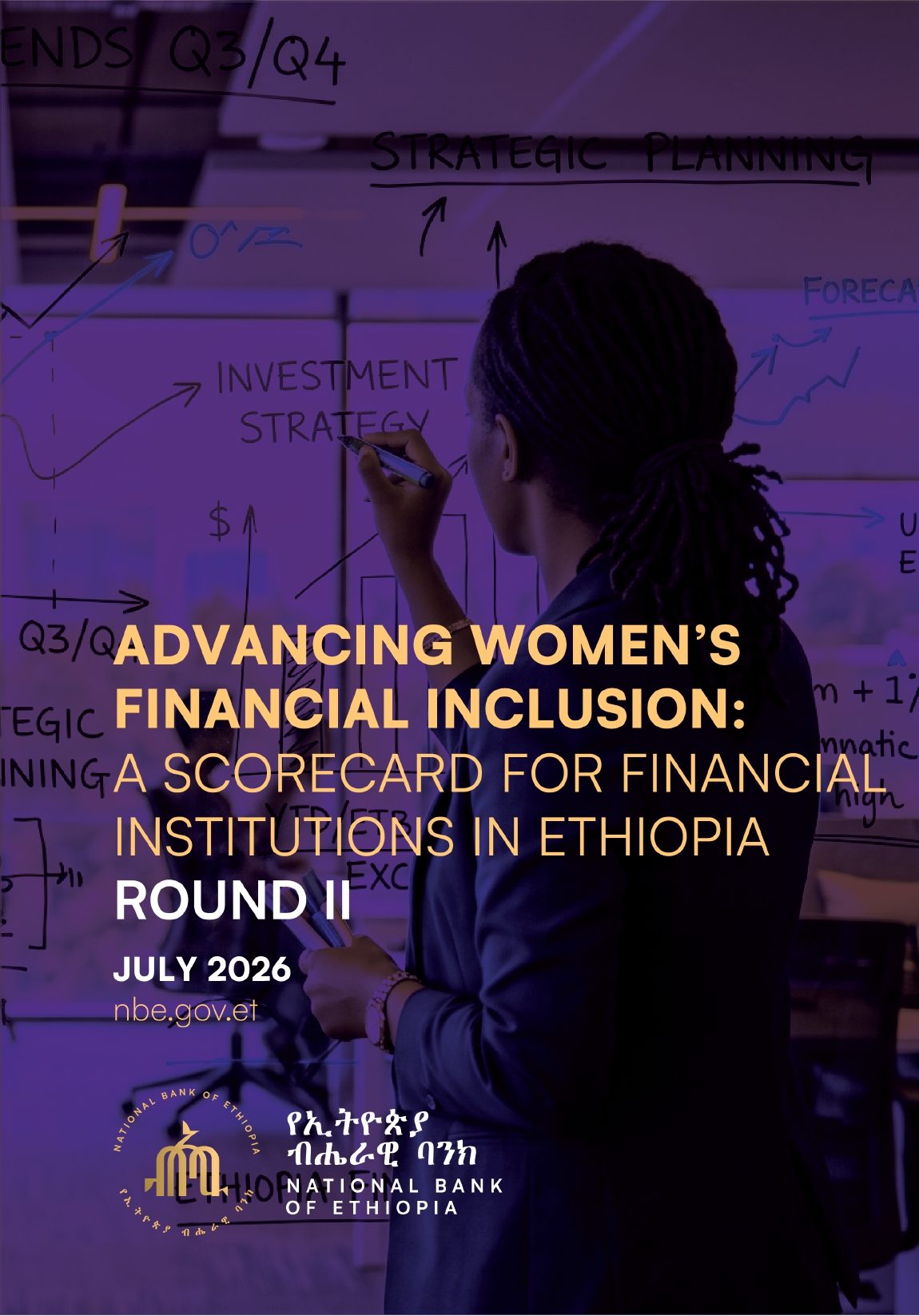
ADVANCING WOMEN’S FINANCIAL INCLUSION: A SCORECARD FOR FINANCIAL INSTITUTIONS IN ETHIOPIA
Context
Ethiopia’s financial sector has made important strides in recent years. With the expansion of digital financial services, new market entrants, and regulatory reforms, there is growing momentum to ensure that financial inclusion advances equitably for all. Yet data continues to show persistent gender disparities. Women remain underrepresented as account holders, borrowers, leaders, and users of digital financial services. Recognizing that inclusive growth requires gender-responsive systems, the NBE, in partnership with the World Bank’s Africa Gender Innovation Lab, has developed a women’s financial inclusion scorecard to support evidence-based action and promote greater transparency and progress across the sector.
Process
The scorecard was co-developed through a collaborative process with over 15 institutions from across Ethiopia’s financial ecosystem. Consultations, pilot testing, and validation sessions ensured the tool reflects both global good-practice and the national context. The scorecard is designed to evolve over time—from foundational metrics toward more transformative practices. The scorecard is not simply a compliance tool but a shared framework to foster internal reflection, institutional learning, and sector-wide accountability.
Key Findings
- Many institutions are already collecting sex-disaggregated data, particularly on customers and employees. However, consistent reporting and strategic use of this data remain areas for growth.
- Sector-wide engagement is growing. Institutions are beginning to act on inclusion, though strategies are not yet fully embedded.
- Workforce inclusion is the strongest area. Driven by government mandates—such as board gender quotas and targets for women in senior management set out in the National Financial Inclusion staregies – banks are increasingly hiring and promoting women, with many achieving gender-diverse boards. However, support systems like childcare, parental leave (beyond the ILO-mandated maternity leave period) and mentorship remain underdeveloped.
- Women’s access to financial products shows moderate progress. While credit outreach is improving, products are often generic and not tailored to women’s specific needs.
- Innovation is nascent. Although some institutions are introducing digital products and alternative delivery models, sector-wide innovation tailored to women remains limited.
The Scorecard highlights encouraging progress in areas where there is strong policy guidance—underscoring that government mandates are translating into institutional action. To build on this momentum, priority areas for further progress include developing gender-intelligent financial products, fostering inclusive innovation, strengthening gender-disaggregated data systems, and embedding gender targets within broader ESG compliance frameworks. Going forward, NBE will use these insights to guide regulatory reform, promote best practices, and support institutions in accelerating inclusion.