NATIONAL BANK OF ETHIOPIA
Monetary Policy Committee Meeting No. 3
The Monetary Policy Committee (MPC) of the National Bank of Ethiopia held its second meeting on Jun 30, 2025. In line with its roles and responsibilities set out in the NBE Establishment Proclamation, the MPC proposes monetary policies for adoption by the NBE Board and consistent with the central bank’s primary objective of maintaining price stability while supporting growth.
30 June 2025 | Addis Ababa, Ethiopia
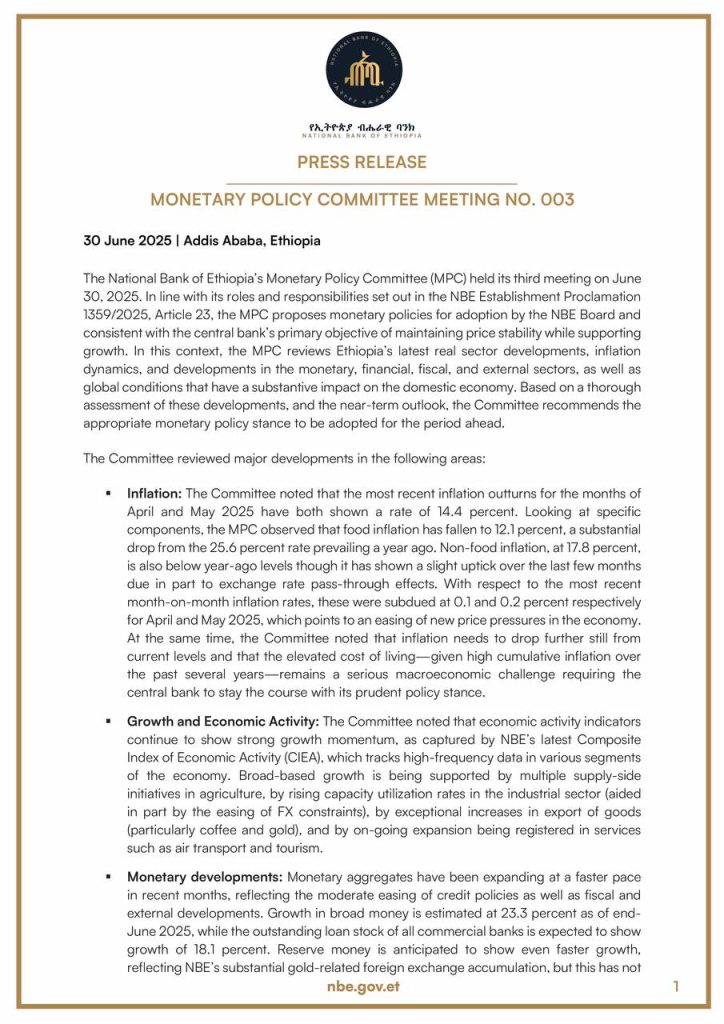
The National Bank of Ethiopia’s Monetary Policy Committee (MPC) held its third meeting on June 30, 2025. In line with its roles and responsibilities set out in the NBE Establishment Proclamation 1359/2025, Article 23, the MPC proposes monetary policies for adoption by the NBE Board and consistent with the central bank’s primary objective of maintaining price stability while supporting growth. In this context, the MPC reviews Ethiopia’s latest real sector developments, inflation dynamics, and developments in the monetary, financial, fiscal, and external sectors, as well as global conditions that have a substantive impact on the domestic economy. Based on a thorough assessment of these developments, and the near-term outlook, the Committee recommends the appropriate monetary policy stance to be adopted for the period ahead.
The Committee reviewed major developments in the following areas:
- Inflation: The Committee noted that the most recent inflation outturns for the months of April and May 2025 have both shown a rate of 14.4 percent. Looking at specific components, the MPC observed that food inflation has fallen to 12.1 percent, a substantial drop from the 25.6 percent rate prevailing a year ago. Non-food inflation, at 17.8 percent, is also below year-ago levels though it has shown a slight uptick over the last few months due in part to exchange rate pass-through effects. With respect to the most recent month-on-month inflation rates, these were subdued at 0.1 and 0.2 percent respectively for April and May 2025, which points to an easing of new price pressures in the economy. At the same time, the Committee noted that inflation needs to drop further still from current levels and that the elevated cost of living—given high cumulative inflation over the past several years—remains a serious macroeconomic challenge requiring the central bank to stay the course with its prudent policy stance.
- Growth and Economic Activity: The Committee noted that economic activity indicators continue to show strong growth momentum, as captured by NBE’s latest Composite Index of Economic Activity (CIEA), which tracks high-frequency data in various segments of the economy. Broad-based growth is being supported by multiple supply-side initiatives in agriculture, by rising capacity utilization rates in the industrial sector (aided in part by the easing of FX constraints), by exceptional increases in export of goods (particularly coffee and gold), and by on-going expansion being registered in services such as air transport and tourism.
- Monetary developments: Monetary aggregates have been expanding at a faster pace in recent months, reflecting the moderate easing of credit policies as well as fiscal and external developments. Growth in broad money is estimated at 23.3 percent as of end-June 2025, while the outstanding loan stock of all commercial banks is expected to show growth of 18.1 percent. Reserve money is anticipated to show even faster growth, reflecting NBE’s substantial gold-related foreign exchange accumulation, but this has not translated into excessive growth in either domestic credit or in broad money due to NBE’s still-binding cap on overall lending growth. Accordingly, excess bank reserves at NBE have risen significantly from year-ago levels, and growth in broad money and in credit have both remained below nominal GDP growth, consistent with NBE’s desired policy stance.
- Interest rate developments: The Committee noted that short-term market interest rates have remained above the policy rate and positive in real terms since December 2024. In the Treasury Bills market, the weighted average yield of 91-day T-bills stood at 17.7 percent in May 2025, up from 16.1 percent at end-December 2024. In the inter-bank money market, the weighted average rate stood at 17.5 percent as of May 2025, which was well within the NBE’s interest rate corridor of 15 percent plus-or-minus three percent. The cumulative transaction volumes in the inter-bank money market continues to grow steadily and stood at Birr 764.2 billion as of June 8, 2025.
- Banking and Financial Sector: The banking sector remained safe and sound, with low NPLs and adequate capital. However, some segments of the banking sector continue to face liquidity challenges, given their high loan-to-deposit ratios. The introduction of an inter-bank money market and a Standing Lending Facility at the NBE has been helping to alleviate the short-term liquidity challenges faced by some banks.
- Fiscal position: Fiscal policy in the review period has been well aligned with the NBE’s tight monetary policy stance. In FY 2024/25, the government has eliminated borrowing from the central bank, which has been highly supportive of the NBE’s monetary policy stance.
- External sector: The Committee recognized that, following the comprehensive reform in July 2024, exceptionally strong performance is being registered in the external sector, as revealed by record growth in export of goods, moderate growth in net services trade, remittances, as well as substantially higher capital account inflows. At the same time, import growth remains muted thanks to price declines in some key global commodities (fuel and fertilizers) as well as owing to the impacts of exchange rate reform. These developments have resulted in a significant drop in the current account deficit, a large overall balance of payment surplus, and a near three-fold jump in NBE’s FX reserve levels.
MPC Assessment and Decision
The Committee noted that NBE’s tight monetary stance has been indispensable to the on-going disinflation process and agreed that this policy stance should remain in place until the intended target of reaching single-digit inflation is satisfactorily achieved.
Accordingly, the MPC recommended and the NBE Board approved the following monetary policy actions:
- First, the Committee decided to maintain the National Bank Rate at 15% while also keeping unchanged existing rates applicable for NBE’s Standing Deposit Facility, Standing Lending Facility, and reserve requirements on bank deposits.
- Second, given the importance of entrenching the recent progress on inflation, the Committee extended the 18 percent cap on bank credit growth until the next MPC meeting in September 2025.
- Third, as part of an effort to remove one of the last remaining elements of direct policy instruments, the Committee decided to repeal NBE Directive MFAD/TRBO/001/2022 that required Treasury Bond purchases by commercial banks. The Committee judges that this change is now feasible given the substantial improvement in the Government’s revenue generation capacity and in its ability to cover the budget’s deficit financing needs through concessional external loans and market-based domestic debt instruments.
- Fourth, the Committee agreed that while the revision of caps on credit growth is anticipated by September 2025—subject to continued progress on inflation—this change will not generate any unintended loosening of monetary policy as NBE will make use of the full range of market-based monetary policy tools at its disposal. These policy tools include the central bank’s policy rate, Open Market Operations, foreign exchange interventions, and changes in reserve requirements—all of which can be used separately or in combination, as warranted, depending on inflationary and monetary conditions.
In closing, the Committee decided that its next meeting shall take place at the end of September 2025 or at any earlier date as may be warranted.
MONETARY POLICY COMMITTEE
NATIONAL BANK OF ETHIOPIA
JUNE 30, 2025